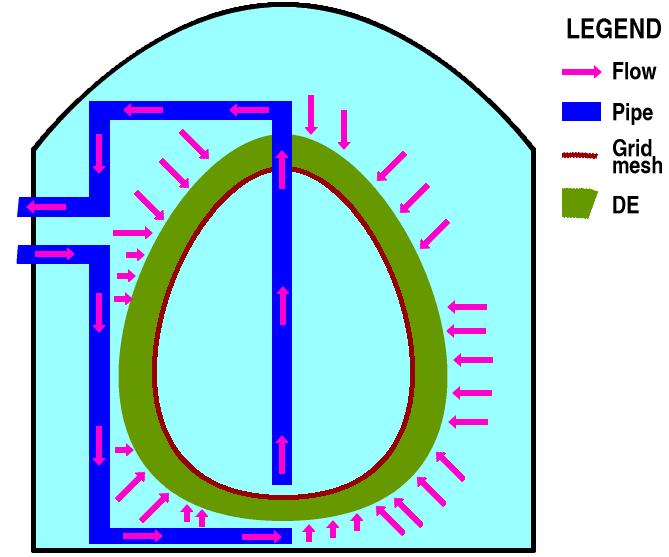
Not shown is the grid framework that prevents the grid mesh from collapsing under pressure.
See the Troubleshooters.Com Bookstore.
|
|
A "Stocking model" of a grid.
Here you see the water come in the filter supply pipe, go to the bottom
of the housing, then push through the DE coated on the outside of the
grid mesh. Once inside the grid mesh, the now purified water goes out
the grid pipe and then out the filter return pipe. Not shown is the grid framework that prevents the grid mesh from collapsing under pressure. |
 |
|
PHOTO of a Grid: This is a
closeup of the technician cleaning one grid. He has cleaned the center,
but the left and right sides have not yet been cleaned yet, so they are
still coated with (dirty) DE. In the clean part, you can clearly see
the fine white mesh that completely surrounds the grid. Below the
translucent fine white mesh, you can see the plastic framework that
holds the mesh in place and keeps it from collapsing inward under
pressure. At the bottom of the picture you see the pipe that lets water escape from the grid. The pipe opening is at the bottom, right at the border between the rightmost dirty area and the clean area. In normal operation, the pipe opening is up instead of down. The pipe runs the length of the grid so that water (and other junk) from the bottom of the grid (which is at the top of this picture) can be pulled out of the grid. In the picture, the technician's thumb is grasping the bottom of the pipe, while the pipe visible at the bottom of the picture is actually the top of the pipe. |
 |
|
FILTER MODE: This is the
normal mode of your filter system. Water comes form the pool, into the
supply pipe of the filter, into the filter housing, through the DE and
grid mesh, out the grid pipe and return pipe and back to the pool. Impurities get caught in the DE surrounding the grid, and are thus filtered out. |
 |
|
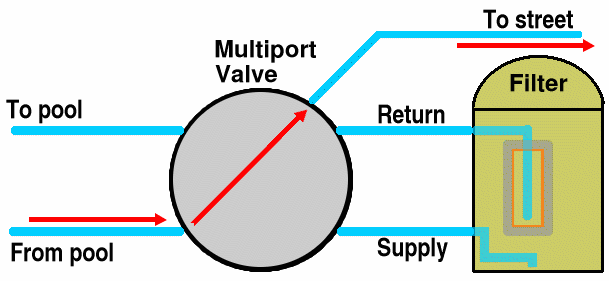
RINSE MODE: Flow is
from pool to filter supply into the filter housing, through the DE and
grid, out the filter return and then out to the street. The purpose here is to get rid of any garbage caught inside the grids so that it doesn't go into your pool. One way such garbage accumulates is during the backwashing process, when unfiltered water is sent to the interior of the grids. |
 |
|
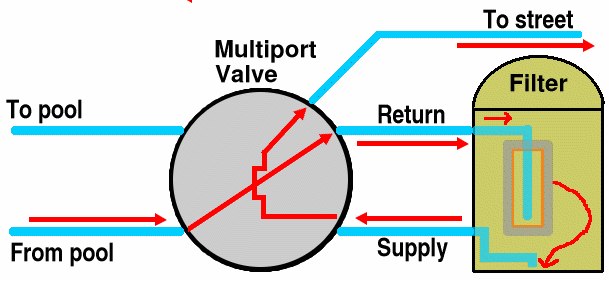
BACKWASH MODE: From the pool
into the filter's return
pipe, to the inside of the grids, through the DE (which should get
blown away and drift toward the bottom, then out the supply pipe whose
opening is at the bottom, and back out to the street. This mode is specifically to send all the DE (which is presumably clogged with pool impurites it filtered out) into the street. |
 |
|
WASTE MODE: From the pool
directly out to the street. The filter is not involved. This is used to lower the level of your pool. |
 |
|
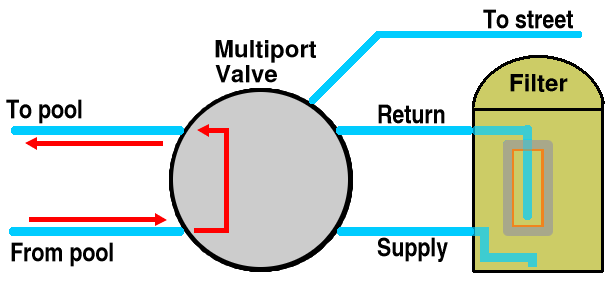
RECIRCULATE MODE: From the
pool directly back to the pool. The filter is not involved. Recirculate is used to provide circulation when you have a bad filter, or to provide circulation when your water is so algae infested that it would harm your filter. In both cases, Recirculate is a temporary measure, and the underlying problem should be fixed as fast as possible. |
 |
|
CLOSE MODE: Blocks off all
circulation. I don't know why it's used, but I hear it's used when you
put a pool to bed for the winter. NEVER turn on the pump while the valve is in close mode. |
NOTE Throughout
this article, whenever you read the word "DE", think of it as "DE or
Fiberclear", unless it's used in a comparison to Fiberclear. |
 |
|
The top of the filter
assembly
has spikes, and is composed of tubes. Note the large tube that
pressfits onto the white filter return pipe. |
 |
|
The techician has removed the
grid assembly and stood it, on its bottom, in a flat, grassy work area. |
 |
|
The technican lays the
assembly flat in preparation to remove the top, and then the grids. |
|
|
The bottom of my filter is
strands of plastic, some orbital and some radial. You can see that the
gapped section of the bottom is directly in line with the return tube
of the top. This is necessary to accomodate the supply pipe in the
housing. Notice also that the two grids that end in the gap end at the same place. This is because the inner of these two is the short grid. If it were as long as the rest, it would bump into the top's return tube. |
 |
|
Here the technican removes
the top of the grid assembly by loosening the nut. He will later remove
and carefully store the nut and its backup washer, and then very gently
remove the top. |
 |
|
The technician uses a nozzle
with a narrow spray to remove all the glommed on DE (or Fiberclear). He
sprays it until it's fairly clean, as you can see. He will spray both
sides. Notice that the end with the pipe rests on the ground. This is
so water trapped within the grid can drain through that pipe. |
 |
|
The technician cleans all the
pipes in the grid assembly top by spraying his nozzle into each hole
and pipe, including the center hole and the large return tube
(upperleft most part of the top in this photo. The technician will also
clean the outside of the top. Note that in this photo the top is upside
down, so that the spikes are down on the ground. The grid pipe holes are in pairs. My experience is the best cleaning takes place when I keep the other hole lower than the hole into which I'm spraying. Make sure to get all residual DE and muck out of all piping. |
 |
|
The technician cleans the
bottom assembly with the hose. Note that the long bolt is still through
the middle of the bottom. |
 |
|
The grids should describe a
circle. The short grid (in this picture the leftmost grid touching the
technician's left leg) goes where a long grid would bang into the top's
return pipe. |
|
|
The standing grid assembly. Note that it's actually standing on the top, so it's currently upside down. |
 |
|
Now that the grid assembly
has been reassembled, the technician turns it right side up (bottom is
now on the ground) and cleans all accessible areas with a narrow stream
nozzle. |
|
|
The technican mounted the
grid assembly inside the filter. Note that the (gray) return pipe from
the grid assembly has slid over the (white) return pipe inside the
housing. |
 |
|
In this photo you see the
round housing gasket wrapped around outside of the filter housing lip.
The whitish looking material on the otherwise black gasket is gasket
grease. Please click the photo to see a much more detailed picture. |
[ Troubleshooters.Com | Email Steve Litt ]
 Copyright
(C)2005 by Steve Litt. -- Legal
Copyright
(C)2005 by Steve Litt. -- Legal
| |